




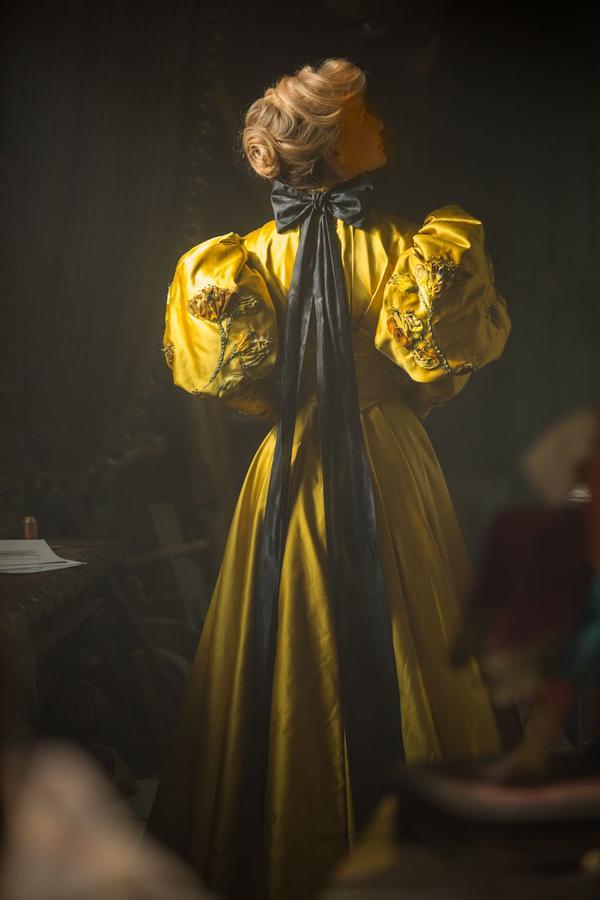
Allerdale Hall concept art
I knew him, Horatio…intimately ;)
Always looking to the past ~ A journey into the lives of Sir Thomas and Lady Lucille Sharpe.
[MATURE AUDIENCE ONLY: Trigger warnings apply]
Feedback is always welcome.
Chapter 2 {below}
CRIMSON PEAK REVISITED
CHAPTER 2
…Today was a most lovely day. The sun was bright and
warm, with the calmest breezes—the flowers are all a-bloom in the wildest riot
of colours. I was moved to take the children for a walk, as that is so rare a
treat for them. Master Thomas enjoyed it immensely. He is at last able to
toddle down the lane without much assistance and pranced along like a Spring
lamb. Miss Lucille, being as well behaved as she is, was more content to walk
beside me, but was ever curious about every single sight, flora or fauna. The
little girl has the most impressive curiosity of the natural world—had she been
born a lad, I believe she would become quite the scholar or even an explorer of
some renown.
Both the children have superior intellects; the signs of
all their good breeding are forefront. Master Thomas has an excitable nature,
however, which I have, sorry to say, indulged to an unusual degree. It is, I
suppose, maternal weakness on my part but the children are so very alone in
this whole dreary house and I do miss my own little ones. I have never seen a
more loveless place for all of Allerdale Hall’s grandiose refinement. Despite all
of my softness, I don’t feel that I’ve spoiled them. Rather the contrary—I act
toward them as if I was their own loving mother and the darlings have responded
with a total devotion. Poor lambs! They are certainly beautiful children. I
only hope that in time their childish exuberance is tempered into a more
sedate, dutiful maturity. At least I shall have done my part in providing them
with some health and cheer…
The nursery in the attic had become a little idyllic kingdom
of its own, behind its religious murals high above the maze of corridors and
fine wood detailing. Allerdale Hall was a vast place, a castle and fortress of
sorts, a monument to privilege and industry. The children were carefully kept
apart from it, locked away like a horded treasure; it was only on the rarest
occasion they were granted permission to venture into the forbidden floors
below, and never without their chaperone, Theresa.
Sir James Sharpe was the model of his genteel station,
having been raised as the heir to Allerdale Hall. He never had reason to
question his privilege, being born as he was to the gentry and enjoying its
benefits as a matter of course. Yet he learned far too soon of the obligations
that burdened him as the sole heir of the estate.
Every son of the Sharpes had been educated to the proud
history of Crimson Peak and the legacy of Allerdale Hall: from its founding on
the remains of a Roman settlement and the prized crimson clay pits hidden
beneath the rolling hilltop, to the granting of the title of baronet to his
industrious ancestor, Sir Edward, by Queen Elizabeth herself, to the fabulously
successful growth of the clay works and masonry. It was of great pride to the Sharpes that
their family supported almost the entire economy of Crimson Peak: their empire
included the clay pits and mines, the kilns and factory, the transport of
bricks, masonry, potteries and other ceramics, and the estate of Allerdale Hall
with the employment of so many servants and groundskeepers. Their influence
extended to even to the little town of Farlam with its train station and the
surrounding farms. For all this, the Sharpe heir was responsible to its
continued success, and if possible to increase the wealth and prosperity of
their position in the gentry.
It was a tragic misfortune that placed Sir James as the sole
heir. His brother, Sir Henry, had purchased a commission with the East India
Company as a means of furthering the family businesses, and had been quite
successful at it, much to the approval of their elderly father, but when James
had barely come of age news reached them that Henry’s ship had been lost in the
Indian sea. Home had been a lonely place before that, as both of his sisters
had died before their brothers–there had been an elder daughter who had not
survived what was to be her first child, who also perished—the same fate that
befell James’ mother, who died birthing their younger sister—and the loss of the
youngest Sharpe girl to a dreadful fever before her fourth birthday had made
Allerdale Hall all the more somber, but the death of Henry broke both the
hearts of James and his father. Henry
had been a smart, steady man, filled with promise and a head for business.
While James had an easy charm, he was far less reserved and more impulsive; it
had never occurred to him that he might be called upon to shoulder the burden
of the Sharpe inheritance alone. Yet it was precisely that which happened when
his father passed away when James had barely entered his twenties.
At loose ends and still mourning the loss of any other
family, James was required to assume his responsibilities as the sole heir of
Allerdale Hall. There were many underlings already in place, fortunately, and
James came to rely on them heavily. He was advised to seek a domestic
arrangement as soon as he could—he had become one of the most eligible
bachelors in Cumberland, if not Britain entirely. These social events provided
a much-needed distraction for the young baronet; he immersed himself in his new
status with an abandon that soon concerned his bankers.
It was not all romance and pleasure, however. Desirous of earning their fees, the chaperons
were hard at work arranging suitable matches for their charges, with Sir James’
attentions being the most sought. It seemed however, the more pursued the man
was, the more he rebelled his obligation; he appeared to prefer the revels and
frivolities of such occasions over the consideration of future domestic
possibilities. It was with some surprise that he found the company of the
spinsters from Whitehaven agreeable, especially over those of younger and
merrier temperament.
Lady Beatrice and Miss Florence were the perfect examples of
their gentle sex, with all the social graces and manners of their status. The
eldest, Beatrice, was the more sought of the two, a charming, intelligent lady with
a quick wit and superior talent, but her sister, Florence, was blessed with far
better appearance and shy sensitivity. Neither was frivolous by any means, but
Beatrice had long had influence over her meeker sister and commanded a great
deal of her loyalty. Florence’s company might have been more delightful had she
not been shadowed by her domineering sibling, but as they had no mother alive,
the younger relied on the elder for all advice and guidance.
At their mother’s passing, Lady Beatrice had taken to her
familial duties with a commitment that belied her tender age. She proved to be
quite capable to the task, too, but the burden was a great one and the lady so
severe that it robbed her of much of her youth. Florence, too, was well
educated and benevolent, known for her kindness and humility. Both were talented
in the musical arts and entertaining company. In addition the two were the only
children of their fine family and of their father’s line, and thus heiresses to
their father’s large holdings. The ladies would provide valuable unions, if
they had only allowed it, but the chaperones could only wring their hands in
despair as years past with no success. There was rumour that Lady Beatrice was
determined to remain unattached, and her sister would not dream of marrying
before her, without her blessing.
I was because the ladies appeared content in their
spinsterhood there was little concern when Sir James was increasingly noted in
their company. Yet the shrewder of the chaperones were not fooled when the young
Sir James proposed to Lady Beatrice; the marriage of two of the richest mining
families of Cumberland was a financially wise union. There was gossip that Sir
James had desired Florence over her sister, but that Beatrice had quelled the
romance and usurped her sister’s place in order to obtain the larger part of
their inheritance. Truth was that the younger sister, Florence, had been the preferred
choice, but the decision to uphold propriety by marrying the elder sister in
place of the sister more likely to produce an heir was applauded. Love had
nothing to do with the matter.
By marrying, Lady Beatrice brought the majority of her
family fortune into her marriage, leaving her sister with a much reduced but still
comfortable allowance. The prospects for Florence finding a good match also
decreased, but Florence continued her sister’s instruction on the care of her
expenses; in truth, for herself she could have gotten by on even less. What
made her bitter was the separation from her beloved sister, for as soon as
James and Beatrice were wed and away to Crimson Peak, a growing distance began.
Florence felt abandoned and friendless, retreating to a lonely obscurity in a
smaller home in Whitehaven and rarely venturing out save for church or
charitable works. Despite the gossip, Beatrice’s break with her cherished
sister was more likely due to Sir James’ control than from any imagined
rivalry.
Unlike many ladies who married late, Lady Sharpe didn’t seem
eager to produce an heir. Sir James didn’t appear overly concerned, but it was
common knowledge that marriage in no way settled his roving, carefree ways. At
least he was discreet and didn’t have any offspring from his dalliances, but
the coldness between the two led to the assumption that either they were unable
or simply unwilling to have children at all. The Sharpes made up for their domestic
deficiencies by excelling in their wealth—a new source of the deep red clay was
found on Crimson Peak itself, near enough to Allerdale Hall to warrant a mine
be dug within sight of the stately manor. Extravagant balls and seasonal
parties at Allerdale soon included tours of the newly built kiln and pottery
works on the property, all humming with the activity of fresh hires.
The increase in fortunes may have led Sir James to consider
the future, for it was with some surprise that two years after they were wed,
Beatrice was expecting a child. She was dreadfully ill during her confinement
and withdrew from society for the duration. When she failed to bear an heir the
rift between the two became even more pronounced. Sir James was quick to hire a
wet-nurse but Beatrice retired to London as soon as she was able, wanting to
resume her role of hostess over any maternal duty. The daughter was hardly seen
and not even given a proper nanny, so great was her father’s disappointment and
her mother’s resentment.
Sir James grew violent when at home, his temper explosive
toward his family and staff alike. He was deep in his cups, and wild with his
fortune and his company. It was no secret that he forced himself on his wife,
and would beat her if there was any refusal of his attentions. It was only when
Beatrice was once again with child that Sir James left off his attacks, but
with the warning that she had better produce an heir or die in the attempt. It
appeared likely she would—Beatrice remained in her bed for the length of the
gestation, through autumn and the long winter.
The birth of little Thomas brought some hope to Crimson
Peak, although it nearly killed his mother. Great care was taken in the
employment of a wet nurse for the newborn heir, with Sir James insisting on her
living at the house where they could monitor the child’s health and growth.
Thinking this would allow her husband to believe she should welcome more of his
attention; Beatrice openly refused to have anything to do with either the nurse
or her charges.
Perhaps it was for the best that the parents remained
distant from Thomas and Lucille. Under Theresa’s care the children flourished:
they were well-fed, clean and most importantly looked after and loved. Thomas
had not been an easy baby, either; he had cried often, only consoled when held
and nursed. He was a delicate infant, but Theresa was a strong and determined
woman, and within two years Thomas and Lucille had grown into healthy, happy
children. The rest of the staff disliked her, finding her too free and cheerful
in her position, and too common in station to be of consequence; they resented
how much Sir James favored her with anything she requested for the children.
…Lucille has excelled with her letters and sampler, and
has shown a great deal of proficiency at concocting balms and salves and other
herbals. She is most content when occupied with some creative endeavor or
reading. Both children have the most avid imaginations—they delight in my
telling of stories and fairy tales, and often sing and dance in little skits of
their own devising. The darlings are so sweet and affectionate to each other
and to me, I almost regret that they will outgrow my care. Lucille will suffer
the greater for it, although Thomas is only recently begun to wean. Lucille
would be a blessing to any mother, the girl being attentive and capable, and l
love her as if she were my own. Yet I fear her passionate nature will not serve
her well in such a house as this…
Returning from the stables, Lucille raced ahead as Theresa
carefully led Thomas up the stairs to the attic. They had spent the day
outside, in the abundant sunshine. Thomas had laughed, running through the tall
grass of the meadows and avidly watched ants marching on an anthill while his
sister rode her new pony, a birthday gift from their father, but the gathering
clouds on the horizon had forced them back indoors for a gloomy evening of
rainstorms. Lucille loved the late afternoons and evenings; teatime and suppers
with Theresa, with food and sweets and story time by candlelight or the light
of the fire. Their parents were away, and that always made things a little more
tranquil, but Lucille missed curling up beside Theresa as Thomas nursed and
Theresa quietly sang lullabies.
Despite the rain lashing the windowpanes and the wind
moaning over the rooftop, Thomas fell asleep quickly. Lucille took longer,
pulling the quilts up around her and asking for yet another story, but when she
fell asleep she dreamt that she was a beautiful princess surrounded by little
sprites, and they danced around a bonfire by the sea, with the dark waves
crashing on the shore beside them. Theresa was there, chanting and clapping her
hands, with red and gold flowers in her hair and covered with a sealskin cloak,
and Thomas was patting a mound of sand and chuckling. The waves grew more
violent, and in the flash of the lightning she could see a ship floundering far
off on the water. The little sprites flew up into the air like flame-bright
sparks and Thomas began to cry, the water bubbling up and washing away his sand
castle; Theresa turned into a seal and the flowers fell from her hair. Crash!
The waves swelled, and Lucille ran over the razor-sharp shells and wet seaweed,
wailing for her brother and nurse…
Lucille woke abruptly, eyes snapping open. The nursery was
dark, the angled timbers of the ceiling like a sheltering tent above them.
Lightning flashed and the wind howled outside. Lucille crept from her bed and
padded to the door. Feeling her way across the parlour, she went into Theresa’s
room and crawled into bed next to her.
“What’s a-miss, sweetest? Did you have a bad dream?” Theresa
murmured, pulling the frightened girl to her. “There, now, it’s all right. Rest
you now; it’s only a storm; it will pass. Your brother’s still slumbering,
isn’t he?” Lucille nodded, sniffling. “Oh, now, a big girl like you, weeping?
No more of that; shall I tuck you back in bed?”
“Might I stay the night with you?” Lucille asked. Theresa
had let her do that before, and she wanted the close comfort of her nearby.
Theresa thought there was no harm in it, and lifted the quilts for Lucille to
burrow beneath. Lucille curled against her, listening to her steady breathing
as she fell back asleep and to the growl and rumble of the storm outside, until
she too fell into a fortunately deep and dreamless slumber.
***
They woke the next morning to the sight of Thomas in his
nightshirt, socks slouched around his ankles and dark locks in wild disarray,
gnawing on a piece of buttered toast and tugging at Theresa’s covers. Lucille
was still curled against Theresa’s side, her head resting on her soft chest
where her gown was undone. The fire in the brick furnace was freshly stoked and
burning bright, making the room welcome and warm despite the still overcast
sky. Theresa sat up with a small cry at the lateness of the hour—they had
overslept! The maid had already been in to kindle the fires and set out their
breakfast; Thomas never slept long for all of his soundness, so he must have
been up for some time. “Help with my egg, please?” he requested.
“A moment, Thomas,” Theresa admonished. “You aren’t dressed
yet, and neither are we. Is the water still hot for the washing?” Theresa rose
in a hurry, urging Lucille up and rushing about with some agitation. Wrapping
the children up in their robes, she allowed them the rare treat of eating
breakfast in their night clothes before the morning ritual of washing and
donning their garments. Having slept well, Thomas was full of energy and
wouldn’t keep still; it was a battle to comb his hair into any semblance of
neatness. Lucille was more sedate, but she tended to enjoy having her hair
brushed, anyway. Theresa had gotten herself properly attended to and was tidying
up the breakfast things when they heard the piano music from downstairs. Mother had returned from town!
Theresa was frantic; no doubt she’d be expected to report to
the lady of the house as to the progress of the children, which Lady Beatrice
always took with a complete air of indifference. Admittedly Theresa was usually
quite carefree and lenient with the children, but she didn’t wish the Sharpes
to think that she was in any way lazy or inattentive to her charges.
“May I go riding again today?” Lucille asked hopefully.
“I doubt very much that the weather shall permit it,”
Theresa answered, handing her the embroidery hoop and half-finished sampler.
“Where has your brother gotten himself to?”
A fit of giggles came in reply to her fretting, and Thomas
dashed away down the corridor. “You little imp!” Theresa cried, giving chase to
her mischievous charge. “You mustn’t run in the house! It is not time for silly
games, lad; come back here this instant!”
Grinning, the boy glanced back at her as he rushed
forward—and ran right into the maid coming up the way to collect the breakfast
things. Wheeling back, he collided with a marble-topped table and sent the ginger
jars displayed on top of it to the floor with a crash. Having followed after
them, Lucille gasped as one of the jars missed the carpet and shattered over
the floorboards.
Thomas froze, and then burst into tears. In a flash, Theresa
had gathered the toddler up in her arms, shushing him. “I am so sorry!” she
apologized, trying to herd the children back into the nursery. The maid frowned
in furious displeasure, muttering as she set the unbroken jar back and bent to
gather up the shards of expensive pottery.
“That was very wicked of you, Thomas!” admonished Theresa.
“And today of all days!” She knew she should punish him, but she couldn’t bring
herself to do so; he looked so contrite and frightened. “Come let me clean your
face. You shall have to give an apology to Betty when she comes in, but for all
our sakes, please sit quietly and look at your book for now. Did you not hear
that your mother is returned?”
They spent the morning in the attic nursery hiding like
frightened rabbits. Betty came and whisked away the dishes, accepting Thomas’
apologies with a silent and tight-lipped disdain. “You should mind Master
Thomas better, between the two of you,” she chided, addressing Theresa and
Lucille. “There’s enough to be done in this house as it is; all the more so
when Sir and Milady are returned. They will want a report at teatime, no doubt.
I’m off, then; too much to do!”
News of Sir James also being home filled Theresa with dread.
Having both master and mistress under the same roof was rarely harmonious, and
Sir James was an intimidating man in any case. The sitting room was close and
stuffy, and the children were anxious. Toys couldn’t distract them, nor could
any promise of music or fairy tales. It was with some alarm that there was an
unexpected rapping on the nursery door before tea time, causing them all to
startle. Theresa rose to answer.
Lady Beatrice Sharpe stood in the doorway as cold and
unmoving as a marble statue. The shock of the invasion, with her piercing gaze
and aloof demeanor, made Theresa shy back from the door, reaching behind her
for the children. Her mistress had never before deemed to visit the nursery,
not even to the parlour. “W-welcome back, Lady Sharpe,” Theresa stammered.
“Children, greet your mother—“
“Spare me the niceties, nurse,” Beatrice snapped. “Bring
your charges into the sitting room at once. I’ve heard of some concerning
irregularities in this nursery and I shall have them addressed at once.”
Gathering the wide-eyed children to her, Theresa followed
behind her mistress with her heart beating wildly. In front of them Lady Sharpe
turned and swept into the front room, seating herself upon the sofa. Without
preamble she began. “It had been brought to my attention that an object of some
worth was damaged this morning—damaged beyond repair, I am informed—due to the
unbridled wildness of the children. Is this true?”
Not knowing what else to do when so confronted, Theresa
nodded. “Yes, milady, it is true, but Betty has granted her forgiveness; it was
a mere accident—“
“That is not the heart of the matter; the jar is now spoiled
and its replacement doubtful. You were derelict in your supervision of the
children; have you at least administered a proper punishment?”
Theresa dare not look up at her employer, lest the truth be
read in her expression. She hadn’t considered the value of the jar, having
thought only that the slight to Betty should be addressed. No doubt it was a
very expensive item.
“I assume you have not,” Beatrice continued without pause.
“Very well, I will take the matter into my own hands, and the boy should
consider it a mercy that it is I rather than his father that administers it.
Fetch me a switch!”
Thomas clutched at Theresa’s skirt in terror, teary blue
eyes as wide as saucers, and Lucille squeezed her hand. Theresa swallowed hard.
“We haven’t a switch, milady,” she replied quietly.
“No switch! How else have you beat them? A belt, then?”
“I do not beat them, milady; there is no need.”
“No need? Master Thomas is heir to this estate and has been
placed in your care with the understanding that he be given a decent and moral
upbringing, not spoiled and allowed to run amok. And the girl—I was told Miss
Lucille was found in your quarters this morning, asleep in your bed, upon your
very breast. Is it true then, that you have grossly indulged them?” Theresa
paled at this accusation, rooted to the spot, helpless to defend herself. “Fetch me a belt, woman, and we shall the end
of this.”
Lucille released her nurse’s hand and boldly stepped
forward. “Please, Mama, it was my entire fault, to both…I crept into nurse’s
room while she slept; she didn’t hear me over the storm—and it was I that
chased after Thomas and broke the jar. I am so sorry, Mama…”
“You will address me as Mother, girl, and only when given
leave to speak,” Beatrice declared. “I can scarcely believe it to be true, but
whether it is or not, this is proof of your failure, Theresa. Go and bring me
that strap, and mind it is a sturdy one.”
“Oh, please, milady, allow me if there must be punishment,”
Theresa cried. As much as she couldn’t bear the idea of striking the children,
at least she could do what she could to soften the blows.
“Having already been too soft on them, I could hardly trust
you to be firm now,” Beatrice retorted. “You may consider it your last act of
your employment. Bring it here and then leave this place immediately. Your
services are no longer required.”
Theresa stood aghast. Numbly she detached Thomas from his
grasp on her skirts and moved like a sleepwalker to fetch a belt that would
meet with Lady Sharpe’s approval. She was not allowed to hold Thomas as Lucille
was told to bend forward and grip the seat of a chair. Tears openly fell from
Thomas’ eyes as Beatrice raised the strap and brought it down over Lucille’s
backside again and again. Yet Lucille didn’t shed a tear or utter a sound, only
stared at Theresa, even when Beatrice paused to insist the woman leave at once.
The little girl’s glassy green eyes followed her as she, without so much as a
farewell, fled Allerdale Hall forever.
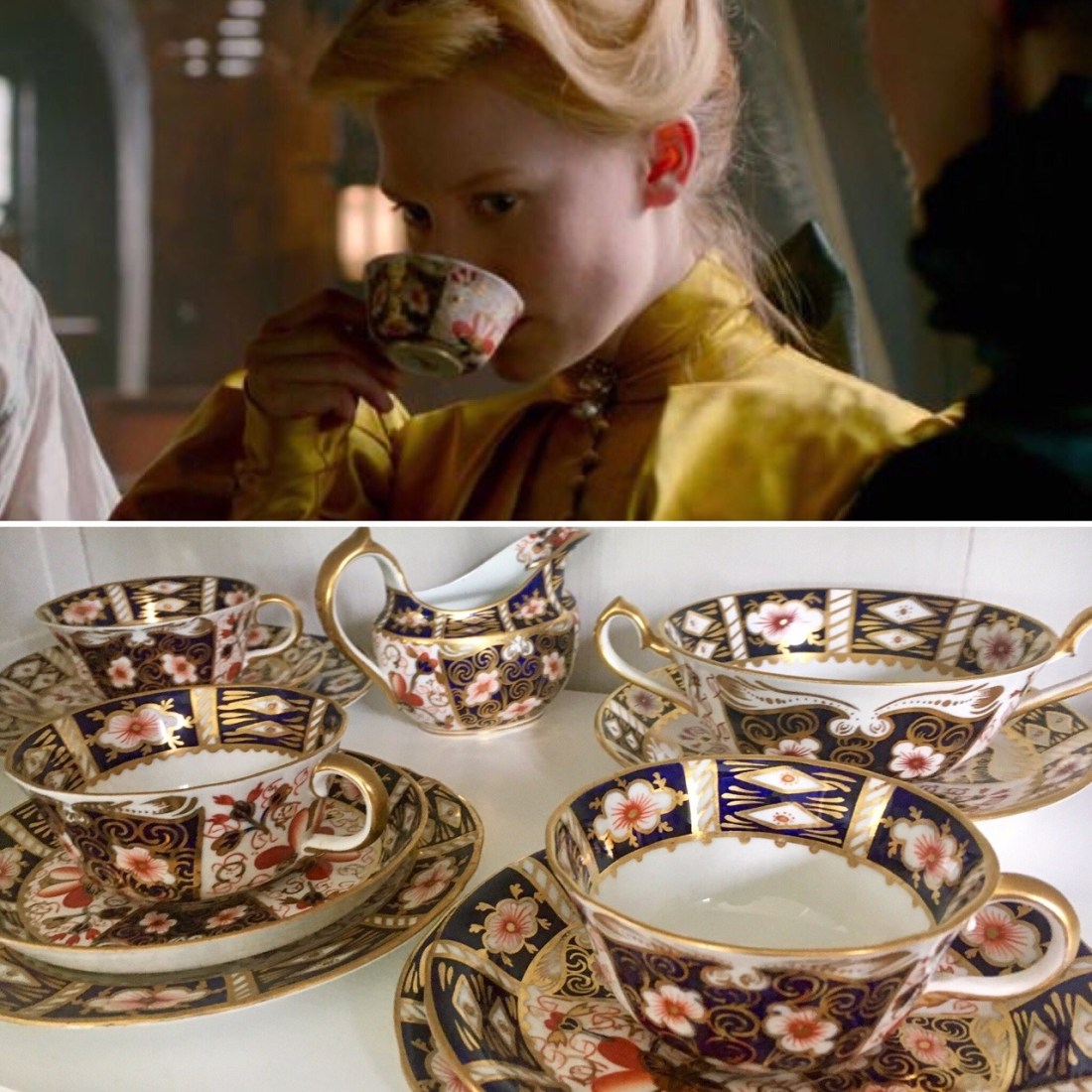
Only the teapot and lidded sugar bowl missing but I’m very pleased! ^^
This is the same kind of infamous set featured in Crimson Peak. 💗Royal Crown Derby – Traditional Imari (1910-1920)
Crimson Peak, and Edith herself, originate from books. Books, in particular, written by women. Young women. Girls, almost – girls like Edith. Mary Shelley, Ann Radcliffe, Daphne Du Maurier, and of course the Bronte sisters; Gothic romance has, since its conception, been the arena of female imagination. Of course men have written in the Gothic mode, but they tend to write a different type. In fact, scholars of the genre consider the line between Gothic romance and Gothic horror to be a gendered one. Where women tend to write stories of social oppression and interpersonal horror, men write ones where the supernatural is actually real, and actually the sinister force at work.
There are many theories as to why this is the case. I favour a simple one: women have long had a great deal of very real things to fear; they do not need to make up ghosts and monsters to menace them.
I didn’t get any feedback on which fic to publish first, so we’re going with the Sharpes backstory as a starter. Enjoy and, as always, any feedback is appreciated.
CRIMSON PEAK REVISITED
CHAPTER 1
Lady Beatrice Alexandra Sharpe of Allerdale Hall was a
bitter husk of a woman. Long resigned to being a spinster, she had astonished
society and disappointed her younger sister, Florence, by accepting the
proposal of the young and charming James William Sharpe, baronet, and joining
him in his newly inherited estate in the hills of Cumberland. Even though the
match was a good one, both families being involved in the lucrative mining
trade and of the same social status, the fact that Sir James was five years the
junior of his wife and she was entering her first marriage in her third decade
fueled the local Whitehaven gossip for many months. Neither were their
temperaments complimentary: Sir James was an imposing, handsome gentleman who
relished his status and the life it allowed him, while both Beatrice and
Florence were aloof and austere ladies who had chosen a more quiet lonesome
existence to the glamour and gaiety their family station enjoyed. As the only
offspring of their noble line, the sisters didn’t appear to care that there was
no male descendant to continue their father’s legacy. Beatrice, who in
childhood had been crowned with a silky cascade of deep auburn hair, had once
housed a fiery temper to match, but had been persuaded by her more retiring
sister to a less visible company. Perhaps it was to spite her that she chose to
marry late in life; it certainly wasn’t for love.
Nor was it for beauty: the severe angles of Beatrice’s face matched
her aloof demeanor and disapproving expression; her height and stiff carriage
making her all the more unappealing. Her ruddy hair had begun to bleach to a
stark white before she had reached adulthood; lines carving themselves into her
wan face like shriveled fruit. Next to her youthful husband, with his full
lips, waves of dark hair and well-maintained moustache, she looked at least a
decade older than her true age. Rumor had it that the baronet had married her
more to gain her inheritance than any other, while others remarked unkindly
that it was well-known that madness was common to the Sharpe men.
Despite the remote location, Sir James and Lady Beatrice
never failed to host extravagant parties at Allerdale Hall. Balls and dinners
and shooting parties were all events with sought-after invitations, never
failing to disappoint. Lady Beatrice would even grace the attendees with her
piano concertos on occasion, in addition to keeping a fine house in London for
the season. Allerdale Hall was filled with fine and rare objects imported from
all over the empire, and the library was well-stocked with volumes on many
subjects, scientific and otherwise. They employed a sizable staff and a great
many locals for the mines, and Sir James was always keen on acquisitions and
investments; the gentleman was expected to go far in his ambitions.
It may be that the baronet’s dogged determination to strive
above his station, to increase his family fortunes and reputation, could
explain his profound disappointment at the birth of his first child being a
daughter. The more jaded among society proclaimed Sir James’ disgust was due to
the thought that he would have to continue his martial obligations with his
sour-faced wife in hopes of siring an heir. Both of the Sharpes were quick to
return to their more public roles, eschewing parenthood and domesticity; the
baby, Lucille, was confined to the nursery and tended to by nursemaids
instructed to keep the infant quiet and unseen.
Lucille was a lovely
child whose looks favored her father’s, with wide eyes and thick, dark hair. A
willful child, she was quick to grow and clever, weaned early and soon became quite
the handful for the staff. Lucille was not provided with a nanny after her
early weaning; rather she was left to a rotation of the maids’ care. Both of
her parents refused to have anything to do with her, not even allowing an
audience with their offspring, and Lucille soon showed signs of having the
worst of her parents’ temperaments. Her tantrums when she misbehaved were
catastrophic, and the staff was instructed to beat the child if needed to keep
her in line. Not able to devote any full attention to the little girl, Lucille
was often locked into the nursery with nothing other than her picture books,
dolls and toys to occupy her, her lonesome existence only broken with solitary meals
and the occasional walks in the gardens. She would stare out of the windows for
hours, and sit silently listening to the noises of the house, from the
scurrying of the servants to the loud arguments of her parents to the rare
treat of her mother’s piano playing.
Blankets of snow still hugged the manor house when Lucille
woke to an unfamiliar sound echoing in the dim light of dawn one morning in
February. There was an unusual amount of activity happening below; filled with
curiosity, Lucille crept to the landing and peered from the shadows of the
hallway.
There were unfamiliar people in the foyer, and Lucille
shrank back as Sir James strode into view. He was uncharacteristically jolly,
his loud voice booming out as he called for the servants to assemble before
him. He returned to the master bedroom, reappearing with a tiny bundle in his
arms. “I present to you my son, the heir of Allerdale Hall!” he declared
proudly. The newborn baby let out a mighty wail, squirming. Sir James beamed.
“Listen to the lad! Strong lungs on this one!” he laughed. A maid nervously
retrieved the baby and vanished back into the bedchamber as the staff
applauded. Lucille caught snatches of the continued conversation as he gave
orders to the butler: “…says the lady is well; she’s done her duty, so she’s
earned her rest…Instruct the housekeeper on the arrangements for the nurse,
won’t you?…We’ll have to have the christening as soon as possible, I
suppose…”
Lucille slipped back to her bed and pulled up the quilts.
The full moon was still in the sky even as the sunlight began to creep in, and
she only pretended to sleep. A baby! There was a new little baby boy in the
house, just as loud as her father. She wondered if all boys and men were like
that. Still listening, she watched the sky begin to glow and grow brighter, the
moon sinking beneath the windowsill. Lucille considered that she had been forgotten,
alone up in the attic. After all, she was almost three years old—and a little
girl was hardly as exciting as a new baby boy.
Lucille was not forgotten—one of the maids came up to build
a new fire in the nursery stove, dress her and leave her breakfast. She was
informed that there was a new baby in the house, her new little brother, and
there was no time for the entertainment of little girls. Now more than ever
Lucille was expected to occupy her time alone and above all, behave. There was
far too much work for the servants to do.
It was only after she was measured for a new frock that
Lucille was told there was going to be a party at Allerdale Hall, one she was
expected to attend: a christening for her brother. The nursery was unexpectedly
invaded by a horde of tradesmen: walls were plastered, floors were sanded and
polished; plumbing was installed. New
furniture arrived; everything was cleaned and shone brightly. Lucille was
filled with wonder and delight, a princess in her shining castle tower. She
soon learned the reason for the embellishments: her brother was to join her in
the nursery, together with his wet nurse, right after the party.
Temporarily displaced, Lucille slunk around the halls,
observing the unusual activity the heir of Allerdale Hall provoked. She didn’t
see the baby at all during those weeks nor had she been introduced, but she
heard him—the baby cried incessantly, day and night. She grew to detest that
noise, worrying that he would continue that racket when he moved in. Eventually
she escaped the confines of the house to spend her time in the stables and the
barn. Lucille spied mice and rats scurrying along on the woodwork; occasionally
the hounds would give them chase. Fascinated, she watched chicks peck their way
out of their confining shells and sprawl out gasping on the straw as they dried
to a fluffy down. There was a litter of autumn piglets grunting and squealing
in their pen, and the horses, cows and goats, even the geese, were all eager to
be let out into the thawing pastureland. Pale green shoots began to poke up in
the ruddy soil of the gardens. Lucille was always scolded for getting muddy,
dirty and disheveled, but she enjoyed the vibrancy of the season around her.
On Tuesdays and Thursdays Lucille was tolerated in the kitchen,
set in a corner with some bits of dough with which to make buns and cakes. It
was too early to search the brambles for berries, but there were still a good
stock of jams put up in the larder. She was allowed plenty of jam and cream for
tea, even if she ate them in solitude for a time, for she was quite pleased
with her new surroundings.
The nursery had become a tidy, cheerful cluster of chambers:
a central sitting room, a bedroom with its cast-iron stove tucked in a far
corner, her narrow brass bed nearby and tall windows hung with thick drapes.
Chests of linens and clothes lined the walls, and the window seats had plump
cushions on them. There was a cradle and bassinet set across from her bed, a
rocking chair and footstool nearby. A water closet was built in the passage
between the children’s sleeping quarters and the nurse’s room; Lucille took a
great deal of delight in twisting the shiny knob on the sink and watching the
water gush out of the faucet. She was not allowed in the nurse’s room, of
course: since it belonged to a servant, it was forbidden, but there was enough
to hold Lucille’s attention in her own updated domain.
At the christening the crowd of aristocrats that filled the
stately front hall, salon and great room fluttered around the elaborately
carved panels of Allerdale Hall like glistening, brightly colored butterflies. Lucille
had been washed and scrubbed until her skin hurt, her dark hair brushed and
plaited into long ebony ropes fastened with silk ribbon bows, her new blue dress
rustling around her in layers of ruffles, but she felt plain surrounded by so
many finely dressed ladies. Lucille did her best to behave, standing still and
staring at the Persian rug when presented to her parents in their bedchamber.
She rarely had been summoned to this mysterious room, and was almost afraid to
raise her eyes.
There was some compliment of her appearance and demeanor,
and she glanced up, catching sight of two skirt hems. There were two women
seated in front of her—her mother, Lady Beatrice, and another stern-faced
woman, almost identical to her, who was introduced as her aunt Florence. Her
father was facing the fireplace, glancing at his pocket watch. An unfamiliar
woman sat on the wide settee, holding a little bundle draped in snowy white.
“Hullo, Miss Lucille. Come and meet your brother,” she said, and her voice was
soft and gentle.
Lucille looked around hesitantly, unsure if this was
permitted. Unable to resist, she stepped forward to peer at her sibling. He was
so little, perfect, with a crown of wispy dark locks and a rosebud mouth,
sleeping and quiet for once. “Hullo,” Lucille murmured. She had never seen
anything so angelic, not even in picture books.
Sir James snapped his pocket watch closed. “It’s time,” he
declared. “Let us proceed.” He turned and offered his arm to Lady Beatrice, who
took it but walked stiffly beside her husband. The nurse stood with the baby
and was ushered forward. “You go along with Lady Florence, miss,” she said as
she passed into the hall, “We’ll take you both up to the nursery after the
ceremony.”
The Sharpes descended the staircase like a royal procession.
The crowd in the salon parted like waves of a multi-colored sea as they paraded
down this impromptu aisle to stand before the minister. Lucille knew to keep
quiet and still, watching everything with an owlish intensity as the baby was
passed along to Lady Florence, who was given the honor of godmother, and handed
on to the clergyman, who announced the name of Thomas for the infant and
sprinkled holy water on him, concluding with a prayer and a reversal of the
baby passing. Thomas woke when he felt the water droplets on his head,
whimpering and squirming; his public exhibition was brief before the siblings
were whisked away, up the staircase to the remote quiet of the nursery.
The nurse smiled brightly at the sight of the comfortable
nursery as they ascended the staircase. A tray of delicacies and covered dishes
had been set up in the little sitting area, making Lucille’s eyes widen in
happy surprise. The nurse moved on to their bedroom, however. She set the still
agitated Thomas down and deftly removed his christening gown, changed his
nappy, dressed him in simpler garments and swaddled him with a practiced
efficiency. “I need to nurse master Thomas,” she remarked, gathering up her protesting
charge. “Do take something from the tray, Miss Lucille. We’ll have a proper
meal after I get him settled.”
Lucille raced to the tray and snatched up a currant bun,
skipping back and climbing up onto her bed. Although she should have eaten in
the parlour, she couldn’t resist the novelty of her new brother and nurse, and
didn’t want to miss a moment.
The nurse had settled into the rocker, with her blouse
unbuttoned and Thomas pressed to her pale, round breast. Eyes open and bright,
the little one suckled enthusiastically, waving his tiny fist in the air. The
woman sighed contentedly, rocking at gentle pace. Lucille was enraptured; it
was almost spiritual to witness, like the icons painted in the frescos at the
very top of the grand entryway. Lucille didn’t recall feeling so comfortable
with her own wet-nurse; an overpowering love rushed through her, both for her
brother and his nurse. They truly were a blessing, a miraculous gift that
brought a long-needed hope to her life and their home.
After a time Thomas drifted off to sleep and was placed in
his cradle. Properly buttoned up, the nurse held out her hand to Lucille, silently
leading her to the parlor and setting her on the sofa. “Now we shall have a
little party of our own, miss,” she declared. Lucille nodded, not daring to
even smile. Perhaps she was dreaming.
“How dour you look! Well, we need to be properly introduced.
My name is Theresa, and I’m going to tend to you and Master Thomas for a time.
Is that agreeable to you, Miss Lucille?” She smiled and offered her hand to the
little girl, who had never had such kind attention before. Lucille stared for a
moment before placing her hand in Theresa’s. “Poor child! Have you a voice? You
needn’t be shy here with me.”
Lucille slowly nodded, remembering her manners. She gave a
small curtsy. “Pleased to meet you, Miss Theresa. It is agreeable to me, thank
you.”
Theresa patted her hand. “Ah, now I can hear you! Such a
polite lady you are! You did quite well at the ceremony; I’m certain your
parents are pleased. You must be quite hungry by now. Shall I serve us some of
these lovely delights?” The woman took up a plate and set it in front of
Lucille, followed with a saucer and teacup, spoon and serviette. She piled a
large amount onto Lucille’s plate and filled her cup from the still warm pot.
The liquid inside was thicker than tea—chocolate! Lucille could barely contain
her excitement: she could recall only having had hot chocolate once before.
“There are those that might say all these riches will spoil a child’s appetite;
nonsense! Nothing wrong with having treats for such an occasion. Sweets for the
sweet, say I! Never seen a child yet that wouldn’t benefit from them, and I’ve
had eight of my own!”
“You’ve a family?” Lucille queried, surprised.
“Yes, my dear, I’ve a family of my own away in the North,
but I’m here to tend to you and your brother now. You must have been very
lonely up here, without a nanny to look after you, but never mind that. We shall
have lots of fun together.” Serving herself, Theresa laid a cloth over her
dress and nibbled at the edge of a biscuit.
Piano music began to waft up from below, over the murmurs of
the crowd. Lucille thought Theresa was far prettier than Mother, and the
kindest person she had ever known. “What sort of fun?” she asked, curious.
“What sort do you like?” Theresa replied. Lucille shrugged.
She hadn’t any idea of fun, other than her own occupation of the long, solitary
hours of the day. “Well, I can tell you stories—I know lots of them—and perhaps
we can sing. I can show you how to sew and sketch, and perhaps teach you your
letters. When the weather improves, we can go for strolls in the garden. You
can have tea parties with your dolls, and you can play with your brother when
he’s old enough. Would you like that?”
Lucille nodded enthusiastically. “Oh, yes, please, I would
like that very much!” she exclaimed. A baby brother was a blessing indeed, if
he brought such gifts with him. Lucille could hardly wait to see what new
adventure awaited her, now that she had company.






 Slutty Yorick